








 |
 |
 |
 |
 |
 |

Range and introduction to the species:
| 1. |  |
The distribution area of Dasypeltis scabra (Linnaeus, 1758) extends only over parts of South Africa. (Status 2024) | 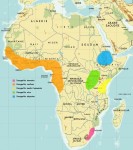 |
click the thumbnail |
|||
| 2. | Dasypeltis atra (Sternfeld, 1912) is a montane species that occurs not only in the mountains of Ethiopia, Uganda, Rwanda and Burundi, but also in the lowland regions where it has an entirely different coloration. The montane form is mostly black, whereas lowland specimens may also be uniformly red or olive and exhibit a pattern. | 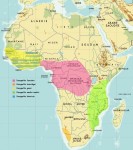 |
|
| 3. | The ranges of Dasypeltis m. medici (Bianconi, 1859) and D. m. lamuensis overlap in the north of the D. m. medici range. It extends from the south of Kenya through Tanzania into the north of South Africa. | 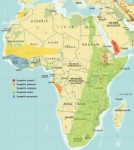 |
|
| 4. | Dasypeltis m. lamuensis (Gans, 1957) occurs in Kenya and Tanzania. There are uniform gray and reddish specimens. | click the thumbnail |
|
| 5. | Dasypeltis inornata (Smith, 1849) only occurs in South Africa (endemic species), and may be reddish brown or dark brown. | ||
| 6. | Dasypeltis palmarum (Leach, 1818) lives in the southwest of the African continent. Its range extends from the north of Angola to Gabon. | ||
| 7. | Dasypeltis fasciata (Smith, 1849) has the second widest distribution range of all egg eaters. It includes the whole of Central Africa and stretches from Ghana to Gabon in the western half and into the west of Uganda in the eastern half. | ||
| 8. | Dasypeltis abyssina (Duméril, Bibron & Duméril, 1854) lives in Ethiopia. | ||
| 9. | Dasypeltis confusa (Trape, J.-F. & Y. Man�, 2006) is known from Senegal (Casamace) to Congo and Angola. She lives in wooded savannah and dry forest. D. confusa is reaching the rainforest in Central Africa (northern Congo). | ||
| 10. | Dasypeltis sahelensis (Trape, J.-F. & Y. Man�, 2006) occurs in Morocco and the Sahelzone from Senegal, Gambia, Burkina Faso, the southern parts of Mali and Niger. | ||
| 11. | Dasypeltis gansi (Trape, J.-F. & Y. Mané, 2006) is only known from the coastal area of Senegal and Gambia. | ||
| 12. | Dasypeltis latericia (Trape, J.-F. & Y. Mané, 2006) range is from Senegal, Gambia, Burkina Faso, the southern parts of Mali and Niger and the northern parts of Guinea, Ghana, Togo, Benin and Nigeria. | ||
| 13. | Dasypeltis parascabra (Trape, S., O. Mediannikov & J.F. Trape, 2012) is a new species from West-Africa. Dasypeltis parascabra occurs in Guinea, the Ivory Coast and Sierra Leone. | ||
| 14. | Dasypeltis loveridgei (Mertens, R. 1954) lives in southern Namibia and the northwest of South-Africa. | ||
| 15. | The Indian egg eater, Elachistodon westermanni (Reinhardt, 1863), is only known from nine localities. Its range extends from central to north India and from there, east to Nepal and the northwest of Bangladesh. This snake is dark brown with a white line running down in the middle of the back. The underside is off-white with some brown spots on the anterior sides. Its size is about 62 cm (males). | ||
| 16. | Dasypeltis arabica (BROADLEY & BATES, 2018) They are only found in northern Yemen and southern Saudi Arabia. | ||
| 17. | Dasypeltis bazi (SALEH & SARHAN, 2016) This species is endemic and only occurs in Egypt. | ||
| 18. | Dasypeltis congolensis (TRAPE, MEDIANNIKOV, CHIRIO & CHIRIO, 2021) This species occurs in Congo, Democratic Republic of Congo, Gabon, Angola and Zambia. | ||
| 19. | Dasypeltis crucifera (BATES, 2018) This species is also endemic and only occurs in Eritrea. | ||
| 20. | Dasypeltis taylori (BATES & BROADLEY, 2018) This species is found in northern Somalia and Djibouti. |